Saturday, March 19, 2011

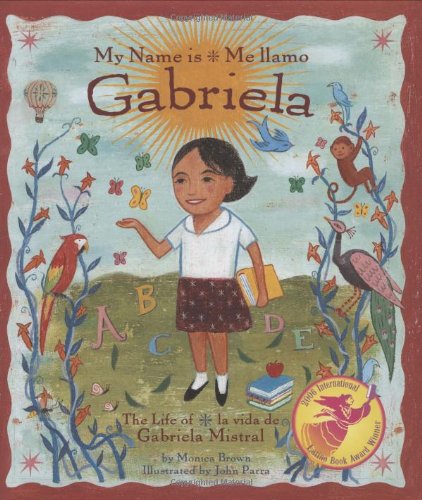
My Name is * Me llamo Gabriela

International Latino Book Award Winner 2006

Citation:
My Name is *Me llamo Gabriela by Monica Brown.  Illustrations by John Parra. (First Impression, 2005). Biographical Junior Book.

Summary:
The biography of the life of Gabriela Mistral as an educator, author, and Nobel Prize recipient.

Critique:
a.         The life story of Gabriela Mistral is expressed in both English and Spanish and visually.
b.         Gabriela’s upbringing and travels are told so the reader can understand what she did in her life that led to being the first Hispanic woman to be awarded the Nobel Prize for Literature.
c.         “My stories traveled the world with me…And because people from all over the world loved my stories so, I was given a very special prize – the Nobel Prize for Literature” (p. 24-26) explains how the stories that Gabriela Mistral has been telling all of her life lad to a coveted award.

Curriculum Connection:  
My Name is * Me llamo Gabriela could be utilized during Hispanic Heritage Month to celebrate Latinos that have made contributions to the world culture.  The story can also enhance a language arts writing prompt where students are studying their own life story. 

Sunday, March 13, 2011

The Frog Scientist

ALA Notable Book 2009
Orbis Pictus Honor Book 2009

Citation:
The Frog Scientist by Pamela S. Turner.  Photographs by Andy Comins. (Houghton Mifflin, 2009).  58p. Informational Junior Book.

Summary:
Dr. Tyrone Haynes and his team include the reader with his field biology and laboratory discoveries while trying to understand the decline in frog populations worldwide.

Critique:
a.         The photographs presented provide an unmistakable visual for the reality of a scientist.
b.         The order of events presented takes the reader from discovery to investigation to a hypothesis of a new theory relating to frog habitat and reproduction rates.
c.         “To test his hypothesis, Tyrone uses a manipulated variable…and a responding variable…The best way of remembering which is which is to think of an ‘if…then’ statement” (p.31) sets up the parameters of the experiment using familiar language with new vocabulary for readers.

Curriculum Connection:  
The Frog Scientist would be well suited for science lessons in most elementary and early middle school classrooms.  The pictures, vocabulary, and explanation can lend itself to the life cycle of a frog, the use of variables within an experiment, and scientific investigation skills.

Saturday, March 12, 2011

Are You Ready to Play Outside?

Geisel Medal Award Winner 2009

Citation:
Are You Ready to Play Outside? by Mo Willems. (Hyperion Books for Children, 2008).  57p. Geisel Picture Book.

Summary:
Gerald and Piggie find fun outside regardless of the weather.

Critique:
a.         The unassuming illustrations provide a balance between colors and simple lines while engaging the emerging reader with the use of easy sentences.
b.         Gerald and Piggie have outdoor plans that are spoiled when it begins to rain.  They soon discover the fun they can have in the rain.  The common language allows the reader to understand all of the emotions they experience as their plans change.
c.         “Now I like rain – and now the rain has stopped!  I am not a happy pig” (p. 50 - 52) takes the reader through the emotions that Piggie and Gerald experience allowing them to make an emotional connection.

Curriculum Connection:  
Are You Ready to Play Outside? is a must have book for any early childhood classrooms that study controlled vocabulary or beginning readers.  The well-known text and engaging illustrations make this book a new favorite.

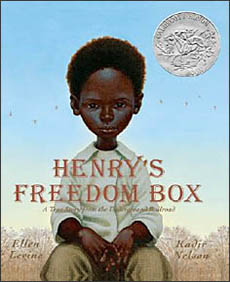
Henry's Freedom Box

Caldecott Medal Honor Book 2008

Henry’s Freedom Box by Ellen Levine.  Illustrated by Kadir Nelson.  Scholastic Press, 2007.  Historical Picture Book.
Slavery, Underground Railroad, Freedom, Shipped, Family, Auction, Container, Assistance, Travel, Brown
Henry ships himself to freedom from slavery in a container.
Henry “Box” Brown’s true story of his escape from slavery on the Underground Railroad is illustrated using shades of brown.  After his family was sold at an auction, Henry seeks assistance from Dr. Smith to mail himself to freedom.  Travel in a container by cart, boat, and rail finally reaching Pennsylvania.

Friday, March 11, 2011

Dan Yaccarino's Mother Goose

City Living, Mother Goose Style

Citation:
Dan Yaccarino’s Mother Goose by Dan Yaccarino.  (Random House, 2004).  41p. Mother Goose Picture Book.

Summary:
Traditional Mother Goose rhymes presented with updated illustrations

Critique:
a.         Familiar Mother Goose rhymes are given a new life with vibrant and entertaining illustrations.
b.         The updated illustrations entrance today’s youngsters in yesterday’s rhymes.  The pictures use bright colors and cityscape backdrops to portray the familiar prose.
c.         Hey Diddle Diddle includes a jazz cat playing the fiddle as the police officer chases the dish that ran away with the spoon, Mary’s garden is growing behind a brick wall, and Mother Goose is riding her gander above cabs and busses helps illuminate the city life of the tattered rhymes.

Curriculum Connection:  
Dan Yaccarino’s Mother Goose embodies what is old can be new again.  This book should be placed side by side with a traditional Mother Goose book to explore how similar rhymes can be interpreted differently.  A great addition to any early childhood classroom, Dan Yaccarino’s Mother Goose, could be used as story extension and nursery rhyme recall.

Bud, Not Buddy

John Newbery Medal Award Winner 2000
Coretta Scott King Medal Award Winner 2000

Bud, Not Buddy by Christopher Paul Curtis.  Delacorte Press, 1999.  Historical Fiction Junior Book.
Adolescent, Orphan, Resilient, Strength, Adventure, Renowned, Runaway, Acceptance, Family, Treasure
A resilient orphan embarks on an adventure searching for his family.
A motherless adolescent demonstrates strength as he embarks on a journey to locate his father, a renowned musician.  A runaway, Bud, discovers the kindness and cruelness of strangers during the Great Depression before locating what he has been searching for.  His discovery provides a treasure to Bud and his new family.

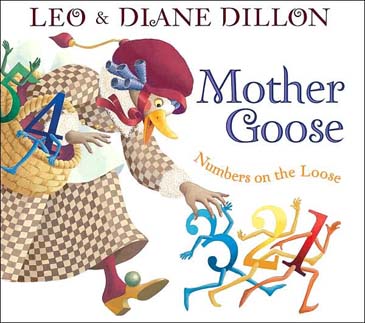
Mother Goose Numbers on the Loose

ALA Notable Books for Children Award 2008

Mother Goose Numbers on the Loose by Leo & Diane Dillon.  Harcourt, 2007.  Mother Goose Picture Book.
Familiar, Favorites, Rhythm, Rhyme, Engaging, Mother Goose, Updated, Classic, Memorable, Numbers
Rhymes both familiar and not retold with new engaging illustrations.
The rhythm of favorite Mother Goose rhymes combined with vibrant depictions embrace the style and prose that readers have come to expect while emphasizing numbers.  Updated and timeless classics create a memorable new childhood favorite.  Engaging illustrations of numbers running at large convey the humor of the rhyme.